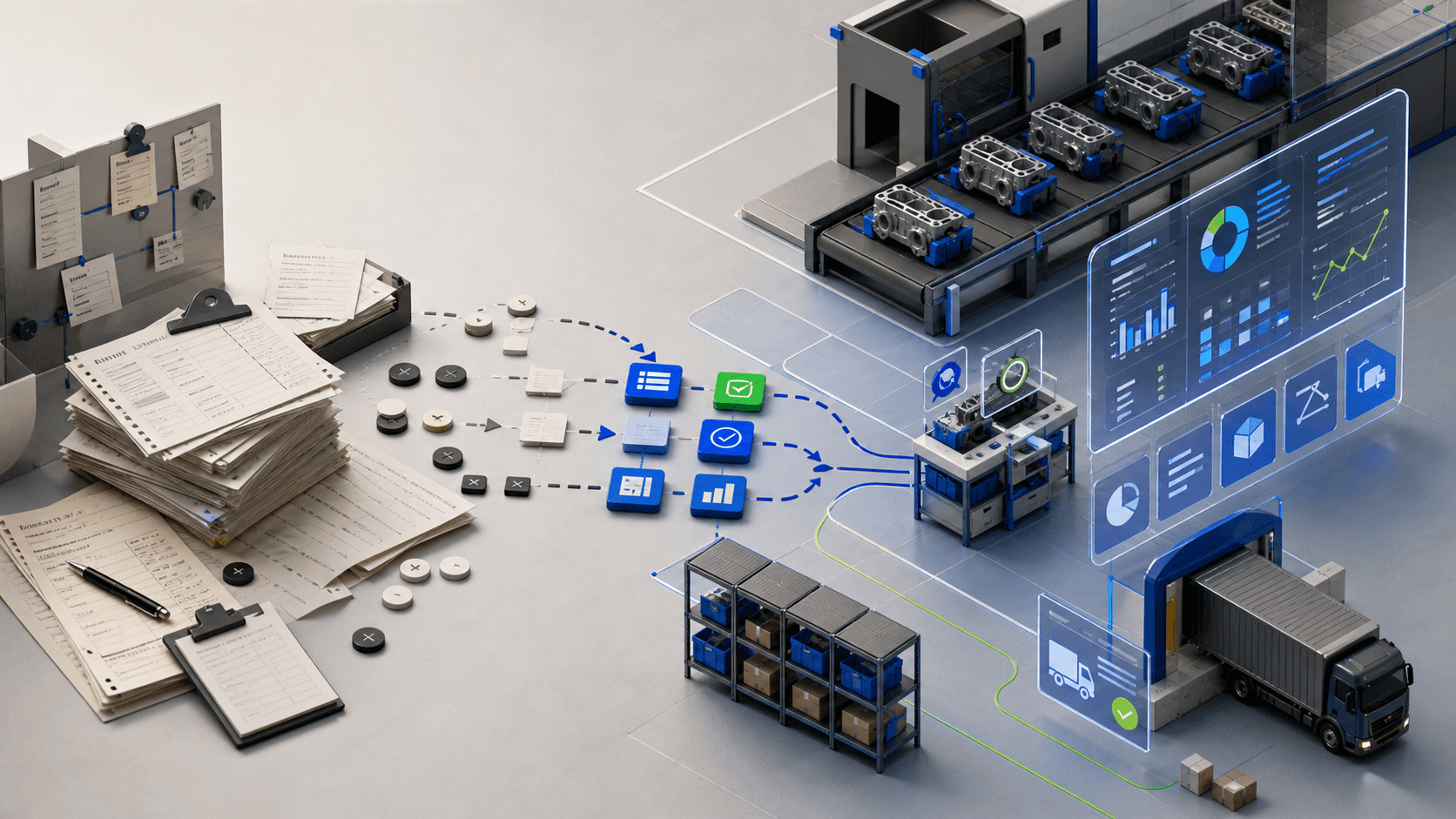
Manufacturing workflow automation does not have to begin with robots, a complete ERP replacement or an expensive smart-factory programme. For many Indian factories, the highest-value first step is simpler: replace one slow, paper-heavy operating process with a reliable digital workflow that people can use on the shop floor.
The right first workflow creates a shared source of truth, captures evidence at the point of work, routes exceptions to the correct person and produces a report management can trust. The wrong first project tries to digitise every department at once and becomes too large to validate safely.
Manufacturing workflow automation: the quick answer
Start with a process that is repeated frequently, creates measurable delay or errors, and has a clear owner. Quality inspection, production reporting, material requests, maintenance tickets and dispatch approval are often stronger starting points than a company-wide transformation. Run a focused pilot in one line, shift or location; measure adoption and cycle time; then expand only after the workflow works under real operating conditions.
| Workflow | Good first-release outcome | Evidence to capture | Useful success measure |
|---|---|---|---|
| Quality inspection | Digital checklist with hold, release and escalation states | Measurements, photos, operator, machine, batch and timestamp | Faster traceability and fewer missing records |
| Production reporting | Live output, rejection and downtime entries | Shift, line, order, quantity and reason code | Reduced reporting delay and better plan-vs-actual visibility |
| Material request | Request, approval, issue and acknowledgement flow | Item, quantity, requester, approver and location | Shorter material-wait time and fewer duplicate requests |
| Maintenance | Ticket, priority, assignment, repair and closure | Asset, fault, photo, response and resolution | Lower response time and a usable maintenance history |
| Dispatch approval | Pick, check, approve and handover sequence | Order, items, vehicle, documents and approver | Fewer incomplete dispatches and faster reconciliation |
The first automation should improve a business result people already care about. “Going digital” is not a measurable outcome; reducing missing quality records or approval time is.
Signs your factory is ready for workflow automation
- Supervisors spend the end of each shift collecting or retyping records.
- The same production number appears differently in paper registers, spreadsheets and ERP entries.
- Approvals depend on phone calls or WhatsApp messages with no durable audit trail.
- Managers learn about downtime, rejection or shortages after the shift has ended.
- Operators enter the same information in more than one system.
- A customer complaint triggers a long search for the relevant batch, check or approval.
- One experienced employee knows how the process works, but the rules are not captured anywhere.
These symptoms do not automatically justify custom software. They do justify mapping the workflow and testing whether configuration, integration or a focused custom layer can remove the friction.
Which factory workflow should you automate first?
Score the pain before choosing the technology
List candidate processes and score each from one to five for frequency, time lost, error risk, traceability need and ease of measuring improvement. Add a sixth score for rollout difficulty, but reverse it: a contained process with one committed owner should rank higher than a process spread across many departments.
Prefer one complete loop over several partial screens
A useful first release should take one record from creation to closure. For example, a quality workflow should not stop at data entry; it should handle a failed check, assign the next action, record the decision and make the history searchable. Completing one loop teaches more than building five disconnected forms.
Keep finance and statutory systems stable at first
If accounting, payroll or tax processes already run reliably in established software, keep them there. The first workflow can exchange approved data through an import or API without replacing the system of record. This reduces risk and keeps the project focused on the operational gap.
A six-step rollout plan for an Indian manufacturing unit
1. Observe the real shift
Walk the process with the operator, supervisor and downstream user. Collect the current form, spreadsheet, message and report. Document exceptions—not only the ideal standard operating procedure—because production software succeeds or fails in the exception paths.
2. Define the record and its states
Name the object being managed: inspection, job card, request, breakdown or dispatch. Then define its valid states, who can move it, what evidence is mandatory and when escalation occurs. This becomes the backbone of the software and its audit trail.
3. Design for the actual environment
Check device availability, gloves, lighting, language needs, network reliability and the distance between the work and the terminal. A responsive web app may be enough; some floors need shared tablets, barcode scanning or offline capture. Do not assume every operator has a company phone or continuous connectivity.
4. Connect only the data that changes the outcome
Integrate order, item, batch, employee or machine master data when it prevents duplicate entry or wrong selection. Delay non-essential integrations until the workflow is stable. Every external dependency adds mapping, authentication, retry and monitoring work.
5. Pilot with one accountable owner
Choose a line, product family or shift with an empowered process owner. Run real work through the system, review usage daily and fix ambiguity quickly. Keep the paper fallback only for a defined transition period; an indefinite dual process guarantees conflicting records.
6. Measure, document and expand
Compare the baseline with the pilot: reporting delay, missing fields, approval time, rework, traceability effort or user adoption. Document the workflow and support route. Expand to the next line or process only when the first release is stable and owned by operations, not only by IT.
What the software should include
- Role-based access for operators, supervisors, quality, maintenance and management
- Clear state transitions and approval ownership
- Required fields, validation and reason codes at the point of entry
- Photo, document, barcode or measurement capture where it proves the work
- Timestamps and an immutable activity history for important changes
- Search, filters and exports that match daily operational questions
- Exception queues and notifications that lead to an accountable action
- Integration monitoring, retries and a manual recovery path
- Backups, access review and post-launch support
A dashboard is useful only after the underlying records are timely and trusted. Invest first in the capture and decision workflow; visual summaries can then reflect what is truly happening.
Common failure modes
Copying a paper form without redesigning the process
A digital copy may remove handwriting but preserve duplicate approvals, unclear ownership and unnecessary fields. Use the project to simplify the workflow before encoding it.
Treating training as a launch-day event
Operators need a clear reason to use the system, short role-specific training and support during real shifts. Supervisors must use the digital record for decisions; otherwise the team learns that paper still has authority.
Measuring features instead of adoption
The number of screens delivered does not show value. Track completion rate, exception age, missing information and the time between the event and its visibility to management.
Automating unstable or disputed rules
If departments disagree about ownership or approval policy, software will expose the disagreement rather than solve it. Resolve the operating decision first, then encode it visibly.
How much does manufacturing workflow automation cost?
A single, focused workflow can often be planned within the same bands used for other custom business systems: below ₹5 lakh for a tightly constrained prototype or narrow workflow, ₹5–15 lakh for a production-ready first system, and higher bands when the scope includes several modules, locations, devices, migrations or ERP integrations. These are planning bands, not quotations.
Cost is driven by roles, exception paths, offline operation, device integrations, data cleanup, security and the number of existing systems involved. Our broader custom software cost guide for India explains how to compare those items consistently.
Frequently asked questions
Do I need to replace my ERP to automate a factory workflow?
Usually not. A focused workflow can sit beside the ERP and exchange master data or approved transactions. Replacement should be considered only when the platform itself creates a strategic constraint, not merely because one process is awkward.
Should the first version work offline?
Only when the operating environment requires it. Offline support adds synchronisation and conflict handling, so confirm network conditions on the actual floor before adding that complexity.
How long does a first factory workflow take?
A contained pilot may take several weeks; an integrated, multi-role production system can take several months. The strongest schedule depends on a narrow release boundary, available process owners, usable sample data and quick feedback from real operators.
Can AI improve manufacturing workflows?
Yes, when the task involves unstructured information or prediction, such as extracting certificates, classifying issues or drafting summaries. Begin with reliable workflow data and human-verifiable outputs. Read our AI automation cost guide for India before adding AI to the scope.
Start with one operating problem
Quickint began in 2018 by digitising paper-led factory operations, and the quality-tracking platform built for Hi-Tech Laboratories in 2020 remains in use. That experience shaped a workflow-first approach: observe the real process, release a contained system, demonstrate progress weekly and stay involved after launch.
Explore our software development work or book a manufacturing workflow audit. Bring one form, one spreadsheet and one painful hand-off; that is enough to start a useful scope conversation.