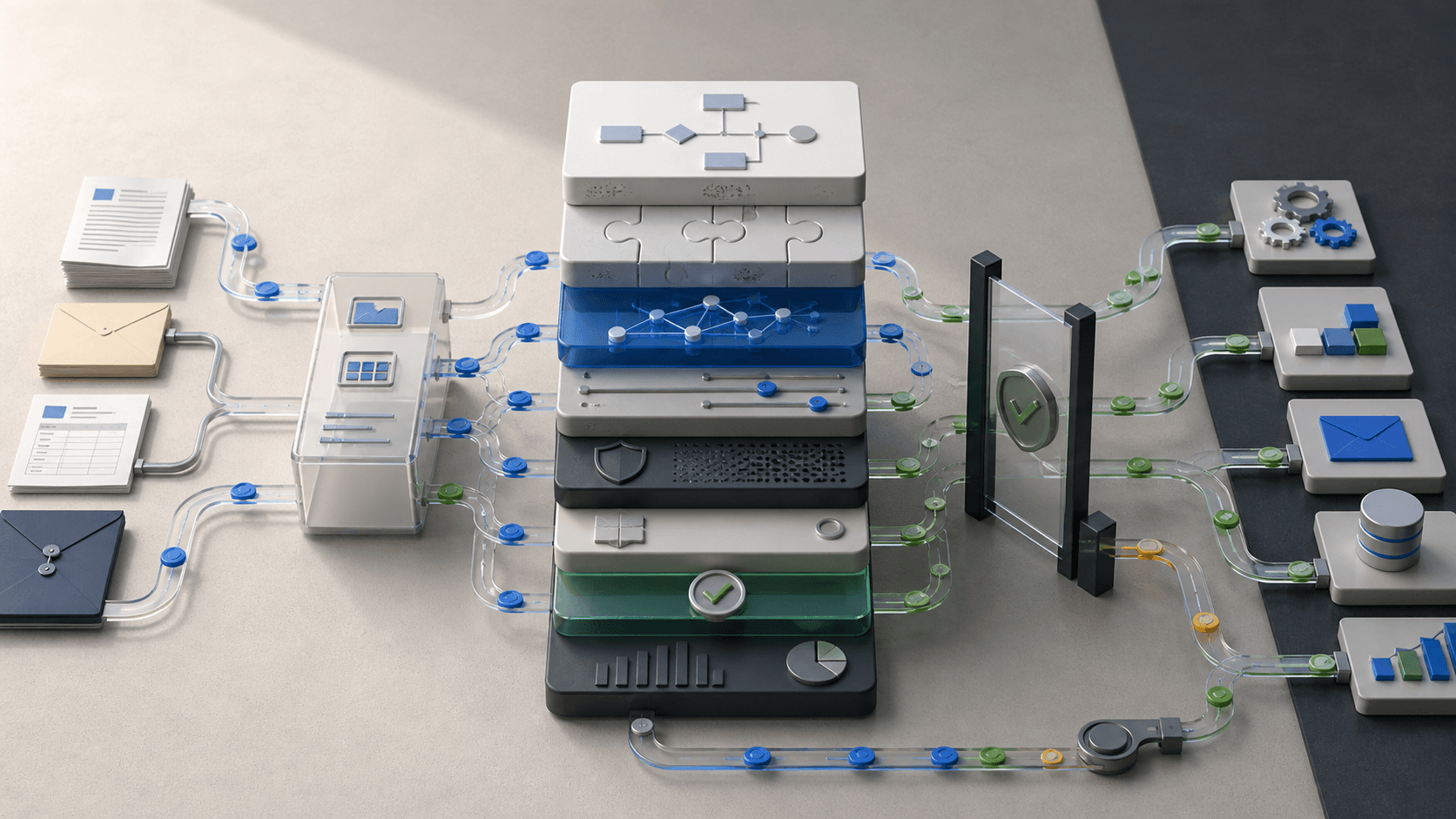
AI automation cost is easy to underestimate because the visible model call is only one layer of the system. A dependable production workflow also needs process design, integrations, permissions, evaluation, exception handling, human review, monitoring and ongoing usage control.
For an Indian business, the useful budgeting question is not “what does an AI agent cost?” It is “what complete workflow will this system execute, how will we verify the output, and what will it cost to operate at our real volume?” Answer those questions before comparing quotations.
AI automation cost in India: the quick answer
Quickint uses the same early planning bands for AI automation as for other custom software: below ₹5 lakh for a tightly scoped proof or narrow workflow, ₹5–15 lakh for a production-ready first automation, ₹15–50 lakh for multiple integrated workflows or a substantial AI-enabled product, and above ₹50 lakh for enterprise platforms or continuing programmes. These are qualification bands, not market averages, fixed prices or quotations.
| Scope | Useful planning band | What the first release should prove | Recurring costs to expect |
|---|---|---|---|
| Controlled proof or narrow assistant | Below ₹5 lakh | Quality on representative data and a clear human-review path | Model/API usage and light hosting |
| Production workflow | ₹5–15 lakh | Real integration, permissions, evaluation, monitoring and exception handling | Model, workflow platform, storage, monitoring and support |
| Multi-workflow system | ₹15–50 lakh | Several roles, systems, use cases and operational controls | Higher usage, observability, security and ongoing optimisation |
| Enterprise programme | ₹50 lakh and above | Governance, scale, reliability, change management and a roadmap | Dedicated operations, audits, model updates and continuous delivery |
A cheap AI demo can become an expensive production system. Compare proposals at the same level of reliability, data access and human oversight.
What you are actually paying for
Workflow discovery and success criteria
The team must observe the current task, define inputs and outputs, quantify volume and identify who owns mistakes. A strong scope states the business measure—time per case, backlog age, handling cost, response time or error rate—and the minimum accuracy or review standard required for launch.
Data preparation and retrieval
AI systems depend on representative documents, messages, records or knowledge sources. Work may include cleaning, permissions, chunking, indexing, metadata, retention and a refresh process. A retrieval demo built from ten clean files does not prove that thousands of inconsistent documents will work.
Integrations and action safety
Reading an inbox is simpler than creating an invoice, changing an order or sending a customer response. Each action needs authentication, field mapping, idempotency, rate-limit handling, audit history and a recovery path. Higher-impact actions should require explicit approval until the workflow has earned trust.
Evaluation and human review
A production system needs a test set representing normal, difficult and unsafe cases. Evaluation checks whether extraction, classification or generation meets the agreed standard. Human review needs a clear queue, context, correction route and feedback loop—not a vague promise that a person is “in the loop.”
Security and governance
Budget for data classification, least-privilege access, secret management, logging, retention, vendor review and incident handling. Sensitive customer, financial, health or employee data may change the viable architecture and model choices.
Monitoring and ongoing optimisation
Models, prompts, data and external APIs change. Monitor quality, latency, failures, usage and cost per completed case. Production support should define who responds when confidence drops, an integration fails or usage suddenly increases.
The recurring cost stack
- Model tokens, images, audio or other usage-based AI services
- Workflow automation or orchestration platform charges
- Vector database, search, storage and data-transfer costs
- Hosting for APIs, queues, scheduled jobs and admin tools
- Monitoring, evaluation runs and log retention
- Third-party services such as messaging, email, OCR or document conversion
- Human review time for uncertain or high-risk cases
- Support, prompt and workflow updates, security patches and vendor changes
Ask vendors to show cost per completed business transaction at expected volume, not only the model price per token. A workflow that retries repeatedly or sends excessive context can cost much more than a disciplined design using the same model.
Four examples of scope changing the price
Document extraction
Extracting fields from one consistent purchase-order format is a controlled proof. Handling many formats, handwriting, tables, duplicate documents, low-quality scans, validation against ERP data and exception review is a production system.
Customer enquiry triage
Classifying an enquiry into a queue is lower risk than drafting and sending a binding answer. The second scope needs approved knowledge, confidence thresholds, escalation, tone control, audit history and protection against prompt injection or sensitive-data leakage.
Internal knowledge assistant
A searchable assistant for public policy documents is different from one that respects department-level permissions across contracts, employee files and customer records. Access control and content freshness often dominate the architecture.
AI-enabled operations workflow
Summarising a maintenance report is simpler than interpreting it, selecting a corrective action, ordering a part and closing the ticket. Separate recommendation from execution and add approvals according to business impact.
How to calculate whether the automation is worth it
Establish a baseline before building. Record monthly case volume, average handling time, waiting time, rework, error cost and the people involved. Then estimate the portion the automation can safely remove or accelerate, subtract recurring platform and review costs, and test the result with conservative adoption assumptions.
Monthly value estimate = time saved + avoided rework + capacity released + faster-response value Monthly operating cost = AI usage + platforms + hosting + human review + support Payback period = build cost ÷ conservative monthly net value
Do not count every saved minute as cash immediately. Time creates value only when it removes a bottleneck, increases capacity, improves service or lets the team stop another cost. Run the calculation with an accountable process owner and review it again after the pilot.
A safer three-stage delivery plan
Stage 1: feasibility on representative data
Use real samples with sensitive fields handled appropriately. Compare AI output with the current human result and classify failures. The deliverable is evidence and a go/no-go recommendation, not a polished chatbot.
Stage 2: supervised production pilot
Connect one workflow, add permissions and logging, and route outputs through human approval. Measure quality, handling time, exception rate and cost per case under real volume.
Stage 3: controlled automation
Automate low-risk decisions that consistently meet the threshold. Keep high-impact or uncertain cases in review. Expand to another workflow only after monitoring and ownership are stable.
Questions to ask an AI automation vendor
- What exact business event starts and completes the workflow?
- Which data will leave our systems, where will it be processed and how long is it retained?
- What representative test set will be used, and how is quality measured?
- Which actions require human approval, and what happens when confidence is low?
- How are permissions, audit history and prompt-injection risks handled?
- What third-party services are included, and which are billed separately?
- What is the estimated cost per completed case at our expected volume?
- How do retries, provider outages, model changes and failed integrations recover?
- Who owns prompts, code, evaluation data, infrastructure and documentation?
- What monitoring and support continue after launch?
Common ways AI automation budgets fail
Starting with a technology instead of a workflow
“We need an AI agent” does not define an outcome. Begin with a repeated process, measurable pain and a verifiable output. The simplest dependable technology should win.
Ignoring human-review cost
A pilot may require every output to be checked. Include that time in operating cost and design the review experience so the person sees the source, proposed action and reason in one place.
Scaling before evaluation is stable
More documents or users amplify failure as well as value. Lock a representative test set and monitor important quality measures before increasing autonomy.
Buying a platform before proving fit
A long platform commitment can make a weak use case look irreversible. Prove the workflow and architecture with a contained engagement before committing to enterprise volume.
Frequently asked questions
Can a useful AI automation be built below ₹5 lakh?
Yes, if it is one narrow workflow with accessible data, limited integrations and clear human review. The budget becomes unrealistic when it is expected to include several departments, autonomous high-impact actions, complex permissions and enterprise reliability.
Are model API costs the largest expense?
Often they are not. Integration, workflow design, evaluation, security and exception handling can require more effort than the model call. At high volume, usage optimisation becomes increasingly important and should be monitored per completed transaction.
Should we use AI or traditional automation?
Use deterministic rules when inputs are structured and the decision is explicit. Add AI for language, documents, classification, extraction or judgement where rules become brittle. Many dependable systems combine both: AI interprets the input, while deterministic software validates and executes the action.
What should we automate first?
Choose a frequent, time-consuming task with accessible data, a clear owner, a human-verifiable output and limited downside when the model is uncertain. Document triage, enquiry routing, extraction and draft generation are often easier to supervise than autonomous financial or operational decisions.
Get a costed AI workflow plan
For the broader build-cost context, read our custom software development cost guide. If the use case is on a factory floor, start with the manufacturing workflow automation guide so reliable process data comes before AI features.
Explore our AI and LLM engineering service or book an AI workflow audit. We will help define the smallest safe pilot, the evaluation plan and the full operating cost before recommending a build.