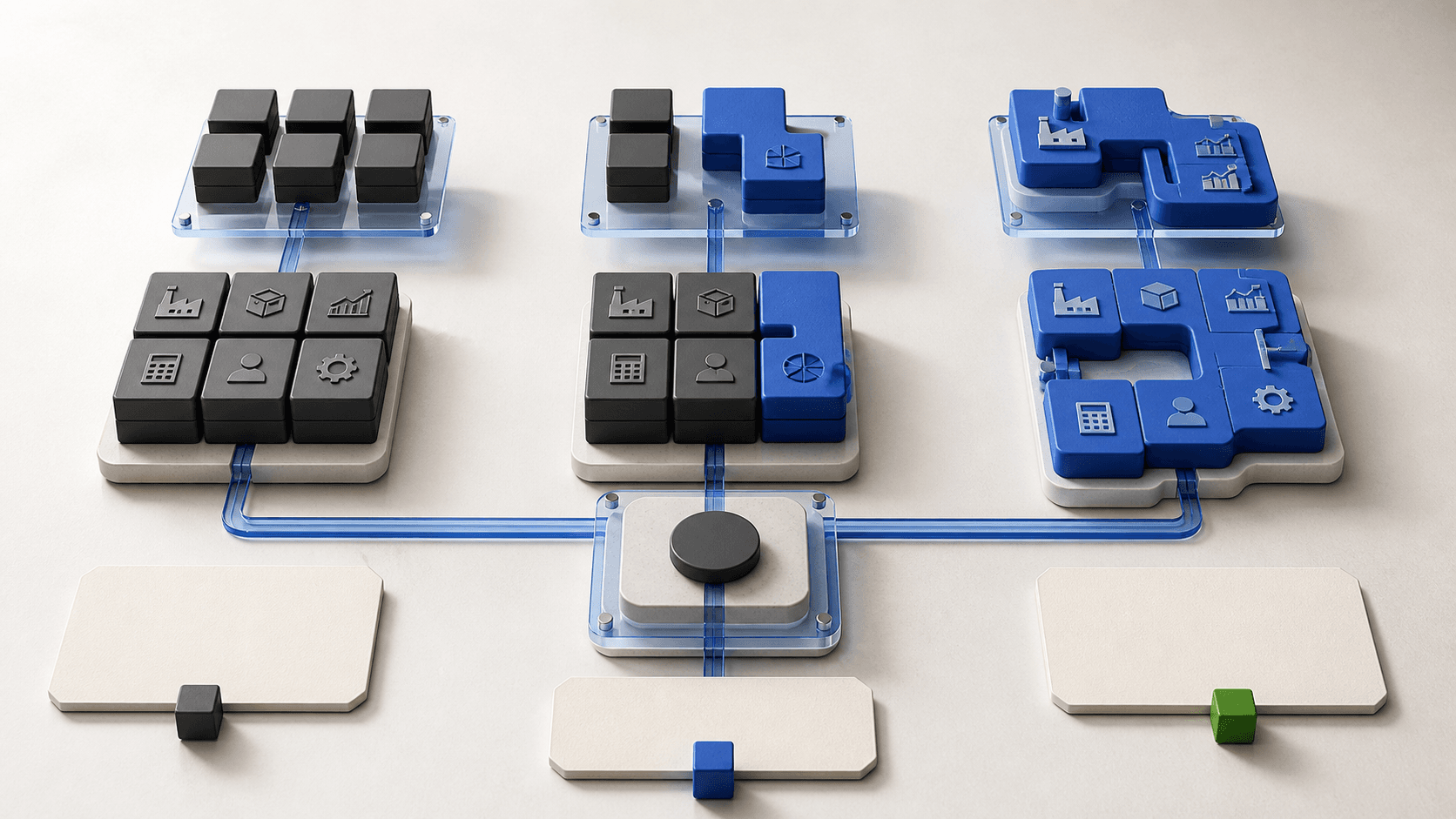
The choice between custom ERP and off-the-shelf software is not a contest between flexible and inflexible technology. It is a decision about where your business should accept standard practice, where it needs a genuine operational advantage, and which system your team can own for years.
For most Indian businesses, the best answer is not a complete custom ERP. A proven package is usually stronger for standard finance, payroll, procurement and compliance. Custom software becomes valuable when a distinctive workflow repeatedly fails to fit the package. A hybrid—standard core plus a focused custom application or integration—is often the most defensible route.
Custom ERP vs off-the-shelf: the quick answer
| Choose | When it is strongest | Main risk | First question to ask |
|---|---|---|---|
| Off-the-shelf ERP | Processes are standard and speed, support ecosystem and built-in controls matter | Teams create workarounds when the configured process does not fit | Can we adapt our process without losing a real advantage? |
| Custom ERP | Core operating logic is genuinely distinctive and the business can fund long-term ownership | Scope, maintenance and key-person dependency grow over time | Which unique workflow justifies owning the entire platform? |
| Hybrid approach | A reliable standard system covers the core but one or two workflows need a better fit | Too much customisation can make upgrades difficult | Can the custom layer remain separate through stable APIs? |
Buy the standard capability. Build the operational difference. Integrate the two when that boundary can stay clear.
What off-the-shelf ERP gives you
Packaged ERP products bring established modules, permissions, reports, update paths, implementation partners and a broader support ecosystem. They can go live faster when the business follows common processes and accepts configuration within the platform's model.
The trade-off is fit. A package may require the team to change terminology, sequence or approvals. That is often healthy when the old process exists only through habit. It becomes harmful when the workaround slows a high-volume activity, obscures traceability or removes a competitive advantage.
What custom ERP gives you
A custom system can model the organisation's roles, rules, data and interfaces directly. It can unify a distinctive workflow and integrate unusual machines, partner systems or operational records without forcing users through unrelated modules.
But ownership is real. The business becomes responsible for product decisions, security, documentation, upgrades, infrastructure and an ongoing development relationship. Source-code ownership alone does not create maintainability; the system also needs tests, deployment processes, documentation and people who understand it.
The five decisions that matter more than a feature checklist
1. Is the process standard or strategically different?
Do not call a workflow unique merely because it is undocumented. Compare it honestly with standard practice. If changing the process would improve control and reduce variation, configure the package. If the process creates customer value or operational leverage, protect it through a custom layer.
2. What is the five-year total cost?
Compare implementation, licences, user growth, customisation, integrations, migration, training, upgrades, hosting, support and internal ownership. For custom software, include continued maintenance and vendor transition. For a package, include implementation partner costs and the effect of additional users or modules.
3. How quickly must the business go live?
A configured product can provide standard capabilities sooner. A custom system should not be chosen if the business needs a broad stable platform immediately and has no time to validate requirements. A phased custom workflow is viable when the first release can remain deliberately narrow.
4. Where should the source of truth live?
Decide which system owns customers, items, orders, stock, finance and employees. Hybrid programmes fail when both systems can change the same record without a clear reconciliation rule. Integration design should define ownership, timing, retries and the manual recovery process.
5. Can your organisation operate the change?
ERP success depends on decisions, data and adoption as much as code. Identify a business owner, clean master data, approve process changes and make time for testing. If no one can own these activities, neither option will rescue the project.
A practical decision scorecard
- Choose off-the-shelf when at least 80% of the important workflow fits after sensible process improvement.
- Choose off-the-shelf when compliance updates, broad reporting and a large support ecosystem outweigh differentiation.
- Consider custom when a high-volume workflow creates daily workarounds across several teams.
- Consider custom when integration and operational rules are the product's core value rather than back-office convenience.
- Prefer a hybrid when finance or statutory modules are standard but production, field service, pricing or customer operations are distinctive.
- Delay the decision when the current process has no owner, no stable rules or unusable data.
The 80% threshold is a decision heuristic, not a universal law. The remaining 20% matters more when it contains the work that differentiates the business.
The hybrid architecture most businesses should evaluate
Keep accounting, tax, payroll or standard inventory in an established platform. Build a focused application for the process that users cannot perform well there—such as shop-floor quality, complex quotation rules, field operations or a customer portal. Connect approved data through documented APIs or controlled imports.
This approach preserves the package's update path while giving the unique workflow a purpose-built interface. The boundary must be protected: avoid writing directly into undocumented database tables, duplicating master data ownership or customising the package so heavily that standard upgrades become a redevelopment project.
For a factory example, see our manufacturing workflow automation guide.
Cost and timeline considerations in India
A configuration-led implementation may have a lower initial build effort but still includes licences, consulting, migration, training and customisation. A focused custom module or internal tool may begin in the below-₹5-lakh or ₹5–15-lakh planning bands, while a multi-module ERP programme can move well beyond them. These bands are only for early qualification; scope and risk determine the actual proposal.
Compare each option using the same five-year assumptions. Our custom software development cost guide provides a fuller breakdown of integrations, migration, security and support costs.
Red flags in ERP proposals
- A demo is presented as proof that your real workflow already fits.
- The proposal does not name which system owns each important record.
- Data cleanup and migration are treated as simple file imports.
- Customisation is promised without explaining the effect on upgrades.
- The team cannot show how exceptions, failed integrations and reversals work.
- User training and process ownership appear only at the end of the plan.
- Source code is promised, but documentation, tests, deployment and support are undefined.
- The quotation lists modules but no acceptance criteria or demonstrable milestones.
Frequently asked questions
Is custom ERP cheaper than packaged ERP?
Not automatically. Custom software removes some licence constraints but adds long-term engineering ownership. Packaged ERP spreads product development across many customers but may add licences, implementation and customisation. Compare total cost under the same users, modules, integrations and support period.
Should a small Indian business build a custom ERP?
Usually only for a narrow, valuable workflow. A young business with changing processes is often better served by standard tools until its operating model stabilises. Building one focused layer can be safer than commissioning an entire ERP.
Can we migrate from spreadsheets directly to custom software?
Yes, but first define identifiers, remove duplicates, resolve missing values and decide which historical records are useful. Migration work should be estimated after inspecting representative data, not only the file count.
Who owns a custom ERP?
The contract should explicitly cover source code, design files, documentation, infrastructure accounts and third-party licences. Ownership should also be practical: your organisation needs access, deployment instructions and a support or transition plan.
Make the boundary visible before buying
Map your processes in three colours: standard, differentiating and unresolved. Configure the standard work, investigate the differentiating work, and fix ownership for the unresolved work before choosing technology. This simple exercise produces a far better vendor conversation than a long generic feature list.
Explore our technology consulting approach or book a build-vs-buy review. We will recommend an existing platform when it is the stronger fit and scope custom work only where it earns its place.